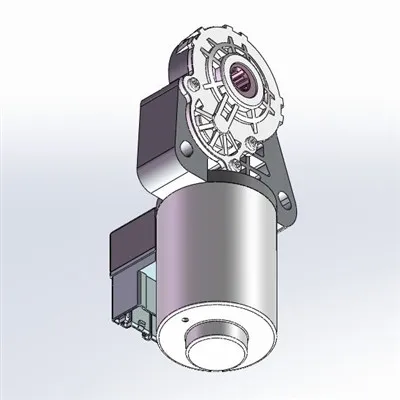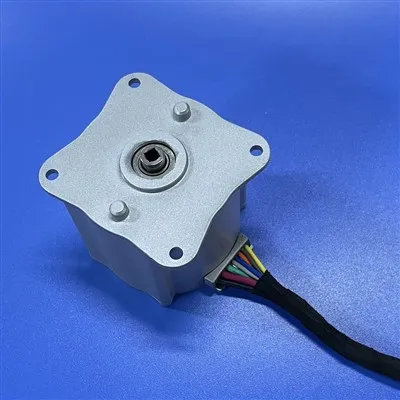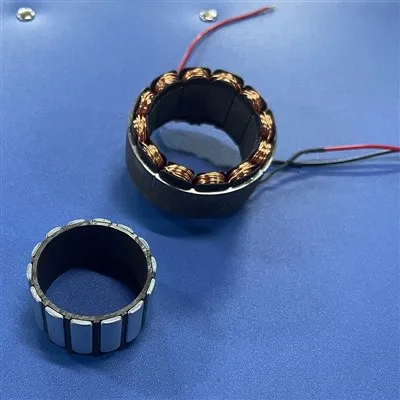


In engineering projects, various types of gear motors are employed to meet specific technical requirements, performance criteria, or spatial constraints. Gear motors incorporate different gear configurations-such as spur, worm, helical, planetary, or even harmonic gears-with planetary gear motors being a common choice for use with DC motors. The two most significant advantages of planetary gear motors are their high power density and compact size and weight. They are generally highly efficient and precise, offering minimal backlash compared to other gear types. On the other hand, planetary gear motors tend to be more costly and feature a more complex design than other configurations.
Applications of Planetary Gears
These gears are sometimes referred to as "epicycloidal" gears, as points on the rotating planetary gears trace epicycloidal curves. The term "planetary" is also apt: the rotation of the entire assembly around a central "sun" gear mimics the motion of the solar system. Planetary gear trains are increasingly used as actuators to generate higher torque from smaller drivetrain components; they are also utilized in differential systems and applications requiring very low gear reduction ratios. The input, output, and auxiliary shafts can be connected to any of the three stages to achieve the specific speed and torque requirements of an application.
Structure of a Typical Planetary Gear System
A planetary gear head consists of a sun gear, an internal ring gear, and a planet carrier assembly that holds three to five planetary gears. The sun gear typically functions as the motor pinion, while the ring gear is usually integrated into the housing. The planet carrier-often manufactured via casting or powder metallurgy-features shafts (pins) upon which the planetary gears rotate. The planetary gears share the load as they orbit the sun gear. The output shaft is generally connected to the planet carrier of the output stage, and lubrication is typically provided by a high-viscosity grease.
Calculating the Gear Ratio of a Planetary Gear System
In most planetary gear motors, the sun gear serves as the input, the planet carrier acts as the output, and the ring gear remains stationary. The sun gear, carrier, and ring gear can each serve as an input or remain stationary. Which component rotates determines the gear ratio, whether the gear set functions as a speed reducer or an increaser, and the direction of the output rotation. The table below shows the final gear ratio for a gear set consisting of an 84-tooth ring gear and a 12-tooth sun gear.
Advantages of Planetary Gear Sets
Improved Repeatability: The ability to handle significant radial and axial loads ensures reliability and robustness, while minimizing gear misalignment. Furthermore, uniform power transmission under varying loads and low vibration levels provide excellent repeatability.
High Precision: Superior stability in rotational positioning enhances motion accuracy and reliability. Typical ratios are 9:1 per stage, with configurations of up to 4 stages achieving ratios as high as 9000:1.
Reduced Noise Levels: Greater surface contact between the gears results in smoother rolling action, virtually eliminating gear chatter.
Enhanced Durability: High torsional rigidity and superior rolling characteristics-supported by bearings that minimize friction-result in lower backlash, higher efficiency, and smoother operation compared to equivalent parallel-axis gear systems.
Excellent Efficiency: The design and internal layout of planetary gear reducers minimize energy loss during operation, ensuring high overall efficiency.
Increased Torque Transmission: High torque density is achieved by distributing the load across multiple planetary gears; the more planetary gears present, the more the load is shared, resulting in a more uniform distribution.
Maximum Versatility: Housed within a cylindrical gearbox, these units can be installed in almost any space. Their compact size and low weight-featuring a 50% smaller diameter while delivering the same torque output as equivalent parallel-axis gear systems-offer exceptional versatility.